
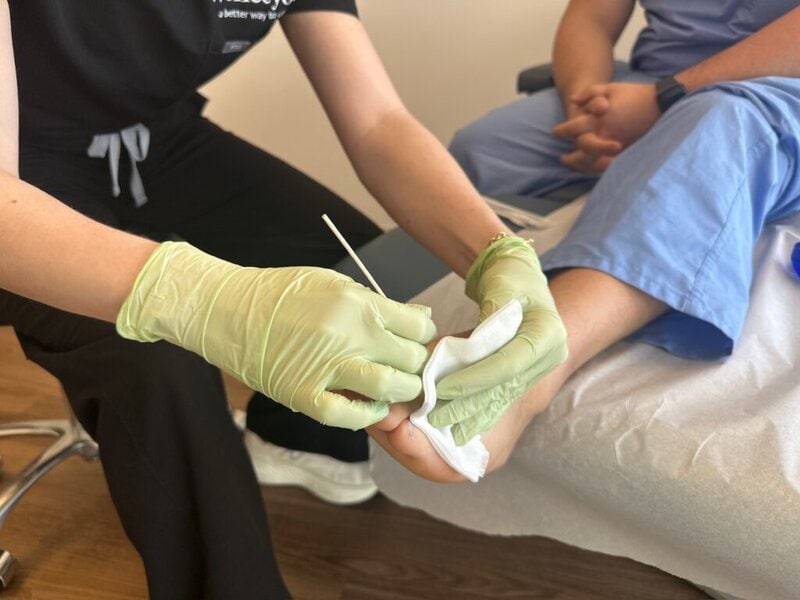
Diabetic Wound Care in Jacksonville, FL
A diabetic foot ulcer is not a bad blister. It is a time-sensitive vascular and infectious problem, and the difference between a wound that closes in six weeks and one that ends in amputation is usually decided in the first two weeks of care.
Well&You provides physician-led wound care across Jacksonville, Orange Park, Fleming Island, and Clay County. What distinguishes our approach is not a particular dressing — it is that every diabetic wound gets a circulation assessment at the outset, because a wound cannot heal in tissue that is not receiving blood, and no amount of advanced wound product substitutes for adequate arterial flow.
Why Diabetic Wounds Are Different
Three problems converge. Neuropathy removes protective sensation, so the injury is never felt and pressure keeps being applied to damaged tissue. Peripheral artery disease reduces the oxygen and immune cells reaching the wound bed. Impaired immune function from elevated glucose lets colonization become infection quickly. Together these turn a minor abrasion into a chronic wound.
The stakes, in numbers: between 19% and 34% of people with diabetes will develop a foot ulcer in their lifetime, and after an ulcer heals, roughly 40% recur within one year, 60% within three years, and 65% within five (Armstrong, Boulton & Bus, New England Journal of Medicine, 2017). Diabetic foot ulcers precede the majority of non-traumatic lower limb amputations.
Recurrence is why our care does not end at closure — a healed ulcer means you are in remission, not cured, and the surveillance plan matters as much as the treatment did.
Symptoms and Warning Signs — When to Be Seen
Do not wait for a scheduled appointment if you have any of the following: a new open sore or blister on the foot, increasing redness or warmth spreading from a wound, drainage or odor, a wound that has not measurably improved in two weeks, a black or dusky area of skin, new foot swelling or deformity, fever alongside a foot wound, or a callus with dark discoloration beneath it — which often means a wound is already forming underneath.
How Well&You Evaluates a Diabetic Wound
- Wound assessment and staging — location, depth, probing to bone, tissue quality, and measured photographic documentation so progress is objective rather than remembered
- Vascular testing — ankle-brachial index, toe pressures (more reliable than ABI in diabetes, where calcified vessels can produce falsely normal readings), and arterial duplex. This determines whether the wound can heal with local care alone
- Neuropathy screening — monofilament and vibration testing to quantify sensation loss and guide offloading
- Infection assessment — clinical signs, cultures when indicated, and X-ray or MRI when osteomyelitis is suspected
- Metabolic and nutritional review — A1C, albumin, and renal function, all of which directly affect healing capacity
The vascular step is the one most commonly skipped elsewhere, and it is the one that changes management most. If arterial testing is abnormal, revascularization moves ahead of wound care in the treatment order — see peripheral artery disease treatment.
Treatments Offered
Revascularization
When arterial flow is inadequate, minimally invasive angioplasty or atherectomy restores circulation to the foot. Performed at the Northside outpatient surgery center. This is first, not last.
Offloading — Including Total Contact Casting
Pressure relief is the single most under-appreciated element of diabetic wound healing. Total contact casting redistributes pressure away from the ulcer across the whole foot and lower leg, and it is the gold standard for plantar neuropathic ulcers because it cannot be removed and skipped. Removable boots and therapeutic footwear are used where casting is not appropriate. A wound that keeps being walked on will not close, regardless of what is on it.
Debridement
Removal of dead, infected, and callused tissue to convert a chronic stalled wound into an actively healing one. Performed in-office as needed, often serially. See wound debridement in Jacksonville.
Negative Pressure Wound Therapy (Wound VAC)
A sealed dressing under continuous suction removes excess fluid, reduces edema, improves local perfusion, and draws the wound edges together. Used for larger, deeper, or heavily exudative wounds.
Hyperbaric Oxygen Therapy
Delivered at the Well&You Fleming Island wound care and hyperbarics center. Breathing oxygen at increased atmospheric pressure raises the oxygen dissolved in plasma, which supports healing in selected diabetic wounds with adequate but marginal perfusion. Candidacy is specific — it is not applied to every wound.
Advanced Dressings, Skin Substitutes and Infection Control
Matched to wound phase and exudate level, with targeted antibiotics for documented infection rather than reflexive prescribing.
Locations Serving Northeast Florida
Fleming Island — Wound Care & Hyperbarics: 4565 US-17, Suite 240, Fleming Island, FL 32003. Mon–Fri 8:00am–5:00pm. Serves Clay County and Orange Park.
Northside (including the outpatient surgery center for revascularization): 15496 Max Leggett Parkway, Jacksonville, FL 32218. Mon–Fri 8:00am–5:00pm.
All locations: (904) 895-5400.
Recovery and Healing Timeline
Most uncomplicated diabetic foot ulcers with adequate blood flow and consistent offloading close within six to twelve weeks. Wounds that have not reduced in area by roughly 50% at four weeks are reassessed rather than continued — that threshold is a well-recognized signal that something in the plan is wrong, usually perfusion, offloading adherence, or unrecognized infection.
Expect weekly or twice-weekly visits initially, tapering as the wound closes. Home care instruction is part of every visit, because most of the healing happens between appointments.
After closure: protective footwear, daily self-inspection, and scheduled surveillance visits. Given the 40% one-year recurrence rate, this phase is not optional.
Insurance and Cost
Diabetic wound care, debridement, negative pressure therapy, total contact casting, vascular testing, and revascularization are covered benefits under Medicare and most commercial plans when medically necessary. Hyperbaric oxygen therapy has specific coverage criteria that must be documented — our team handles that documentation.
Well&You accepts all major insurance plans including Medicare. Patient Navigators provide free insurance verification. Call (904) 895-5400.
Get Seen
Call (904) 895-5400 or request an appointment online. If you have a new or worsening diabetic foot wound, say so when you call.
Written by the Well&You Patient Education Team. Medically Reviewed By Dr. Ragu Murthy, MD, FACC, ABVLM — Founding Cardiologist, Well&You. Reviewed September 2026.